
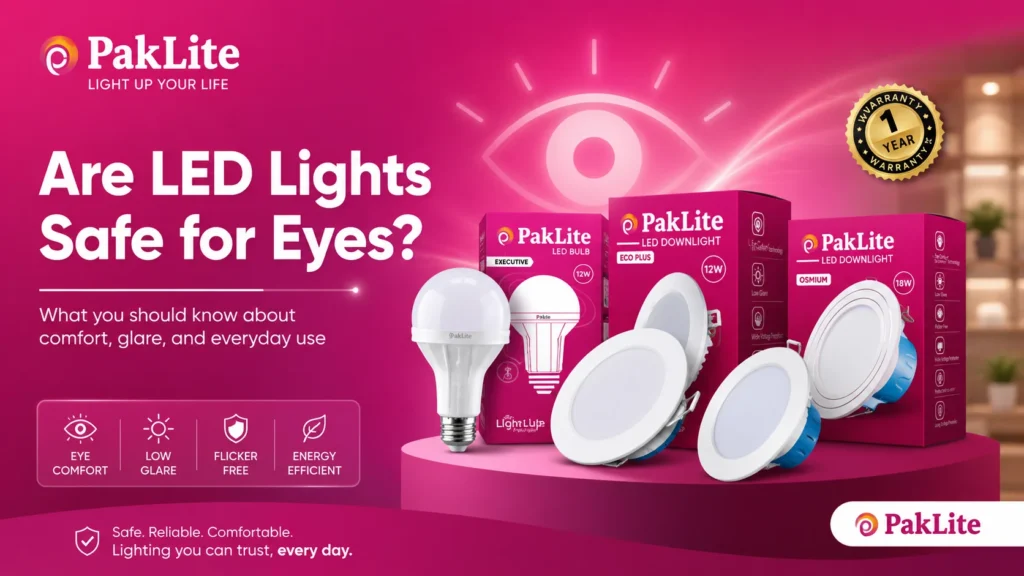
Are LED Lights Safe for Eyes? Myths vs Facts
LED lights are now used everywhere , in homes, offices, shops, warehouses, factories, streets, schools, hospitals, and commercial buildings. They are popular because they save energy, last longer, produce less heat and reduce electricity costs.
But one question still comes up again and again:
Are LED lights safe for eyes and health?
LED lights are generally safe for daily use when the brightness and fixture quality are correct.They do not damage your eyes permanently under normal use.Discomfort usually happens when the light is too bright, poorly diffused, or placed directly in your line of sight.
The truth is simple: LED lights are safe when you choose the right quality, brightness, color temperature, and installation design. PakLite LED lighting solutions are designed to provide reliable brightness, energy efficiency, and comfortable illumination for homes, offices, shops, warehouses, and commercial spaces. Most LED-related discomfort comes from poor lighting design, low-quality products, glare, flicker, or wrong color temperature not from LED technology itself.
Why Do People Ask: Are LED Lights Safe?
LED lighting is now used in homes, offices, shops, and outdoor spaces.Because these lights are bright and energy-efficient, people often ask whether they are safe for long-term use.The real concern is not LED technology itself, but poor-quality products, wrong color temperature, glare, and bad placement.The most common concerns are:
| Safety Factor | LED Lights | What It Means |
|---|---|---|
| Eye Safety | Safe under normal use | Proper fixtures do not damage eyes |
| Sleep Impact | Depends on color temperature and timing | Warm light is better at night |
| Energy Use | Very low | Reduces electricity cost |
| Lifespan | Long-lasting | Less replacement and maintenance |
Myth 1: LED Lights Damage Eyes Permanently
The Myth
These lights permanently damage eyesight.
The Fact
Proper LED lights do not permanently damage your eyes.
LEDs can emit blue light, especially cool white or daylight LEDs, but the level of exposure from standard indoor LED lighting is generally not the same as direct sunlight or unsafe industrial light exposure.
Eye discomfort is usually caused by:
- Excessive brightness
- Direct glare
- Poor fixture placement
- Flickering low-quality drivers
- Very cool light in the wrong environment
- Long screen exposure without breaks
- Poor contrast in the room
So, if someone feels eye strain under LED lights, the issue is usually not “LED light itself.” The issue is often wrong brightness, poor diffusion, or bad placement.
Are LED Lights Safe for Eyes in Offices?
In offices, LED lights are safe when they are installed with proper brightness, color temperature, and fixture placement.Employees may feel eye strain only when the lighting is too harsh, flickers, or reflects directly from screens.For better comfort, offices should use diffused fixtures, neutral white tones, and balanced lighting across the workspace.
For office spaces, use:
• Neutral white light around 4000K
• PakLite diffused LED panels instead of exposed LED chips
• Anti-glare fixtures
• Proper spacing between lights
• Task lighting for desks
• Minimal reflection on screens
Poorly installed LED lights can feel harsh, but a well-designed PakLite LED lighting system can make workspaces more comfortable, professional, and productive.
Eye discomfort is usually caused by:
- Excessive brightness
- Direct glare
- Poor fixture placement
- Flickering low-quality drivers
- Very cool light in the wrong environment
- Long screen exposure without breaks
- Poor contrast in the room
So, if someone feels eye strain under LED lights, the issue is usually not “LED light itself.” The issue is often wrong brightness, poor diffusion, or bad placement.
Myth 2: Blue Light from LEDs Is Always Dangerous
| Area | Recommended Color Temperature | Reason |
|---|---|---|
| Bedroom | 2700K – 3000K | Warm and relaxing |
| Living Room | 3000K – 4000K | Comfortable and balanced |
| Office | 4000K | Clear visibility without harshness |
| Retail Store | 3000K – 5000K | Depends on product display |
| Warehouse | 5000K – 6500K | High visibility and safety |
| Hospital Corridors | 3000K – 4000K | Comfortable and functional |
| Night Areas | 2700K – 3000K | Better for rest |
The Myth
All blue light from LED lights is dangerous for the eyes.
The Fact
Blue light is not automatically dangerous. In fact, natural daylight contains blue light too.
The real issue is timing and intensity.
Blue-rich light during the day can help people feel alert and focused. But exposure to bright, cool light late at night may affect sleep because it can signal the brain to stay awake. Harvard Health notes that blue light at night can suppress melatonin more strongly than some other types of light.
That does not mean LED lights are unsafe. It means the wrong LED color temperature at the wrong time can disturb sleep.
For homes, warm light is better in the evening. For workplaces and warehouses, brighter daylight LEDs can be useful during active working hours.
Myth 3: LED Lights Disturb Sleep
Myth:lights ruin sleep and damage the body clock.
The Fact:These lights do not automatically disturb sleep. Bright, cool light at night can disturb sleep timing.
This applies to LED lights, mobile screens, laptop screens, fluorescent lights, and even bright white lighting in general.
For better sleep-friendly lighting:
- Use warm LEDs in bedrooms
- Avoid 5000K–6500K lights at night
- Dim lights after sunset
- Use lamps instead of strong ceiling lights before sleep
- Avoid bright screen exposure before bedtime
Modern LED technology can actually help create healthier environments because LEDs are available in dimmable, warm, and tunable options.
Myth 4: LED Lights Contain Mercury or Toxic Materials
MYTH
LED lights contain mercury and harmful gases like fluorescent lights.
The Fact
They do not contain mercury.
This is one of the biggest advantages of LED lighting over CFL and fluorescent lights. The EPA explains that CFLs contain small amounts of mercury sealed inside the glass tubing. LEDs work differently and do not require mercury to produce light.
This makes LEDs safer for:
- Homes
- Offices
- Schools
- Hospitals
- Warehouses
- Retail stores
- Public buildings
If a CFL bulb breaks, special cleanup care is recommended because of mercury. With LED bulbs, there is no mercury-related cleanup risk.
LED Lights Are Always Harsh and Uncomfortable
The Myth
LED lights are too sharp, cold, and irritating.
The Fact
LED lights are available in many tones, brightness levels, and fixture designs. With PakLite LED lights, users can choose lighting options that match different spaces, whether it is a home, office, retail store, bathroom, warehouse, or commercial area.
PakLite LED lighting can be:
- Warm
- Soft
- Neutral
- Bright
- Focused
- Diffused
- Dimmable
- Decorative
- Industrial-grade
For example, PakLite LED ARC Downlight, PakLite LED COB Downlight, PakLite ECO Plus Downlight, and PakLite LED Grace Downlight are designed for different lighting needs, from focused brightness to soft and balanced illumination.
Harsh lighting usually happens when the wrong LED is used in the wrong space. It is not always a problem with LED technology itself.
Common causes of harsh LED lighting include:
- Too many lumens in a small room
- Exposed LED chips
- No diffuser or frosted cover
- Very cool color temperature in relaxing spaces
- Poor beam angle
- Bad fixture placement
- Low-quality LED drivers causing flicker
A good LED light should not feel uncomfortable. If it does, the product or lighting plan needs improvement. Choosing the right PakLite LED bulb, downlight, or panel light can help create comfortable, safe, and efficient lighting for daily use.
Are LED Lights Safe for Children?
Yes, LED lights are safe for children when used properly.
- Use warm or neutral white LEDs
- Avoid overly bright direct lights
- Use lampshades or diffused fixtures
- Keep strong white lights away from bedtime routines
- Choose flicker-free LED products
For study tables, neutral white LED light can improve visibility. For bedrooms, warm light is more comfortable.
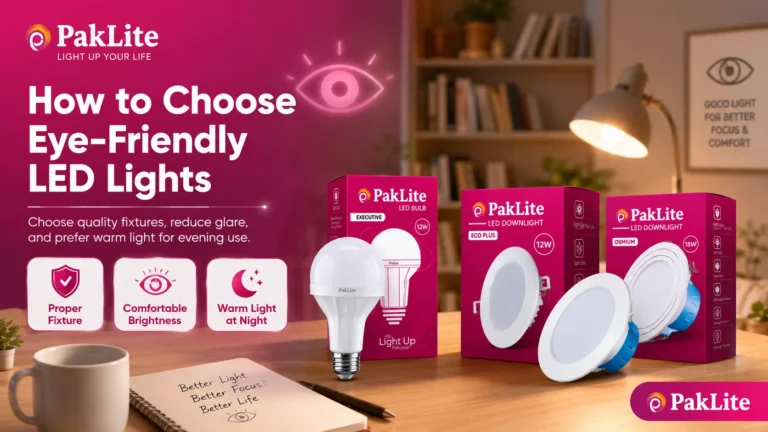
How to Choose Safe LED Lights
To make sure LED lights are safe and comfortable, focus on quality and correct selection.
1. Choose the Right Color Temperature
Use warm light for relaxing areas and cool light for task-heavy areas.
2. Avoid Cheap, Low-Quality LEDs
Low-quality LEDs may flicker, overheat, or lose brightness quickly.
3. Use Diffused Fixtures
Diffusers reduce glare and make light softer.
4. Match Lumens with Room Size
Too much brightness can cause discomfort. Too little brightness can cause eye strain.
5. Use Dimmable Options Where Needed
Dimming helps control brightness according to time and activity.
6. Check Warranty and Build Quality
Commercial-grade LEDs are better for long working hours.
7. Plan Fixture Placement
Even good lights can feel uncomfortable if installed in the wrong direction.
Yes, LED lights are safe for eyes, health, homes, offices, and commercial spaces when the right product and design are used.
The most important facts are:
- They do not contain mercury
- These lights do not damage eyes under normal use
- A good LED Light produce less heat than traditional bulbs
- LED lights can be warm, soft, and comfortable
- These lights concerns are mainly related to nighttime exposure
- Eye strain usually comes from glare, flicker, or poor lighting design
So, the real question is not only “Are LED lights safe?”
The better question is: “Are you using the right LED lights for the right space?”
When selected properly, LEDs are one of the safest, smartest, and most energy-efficient lighting choices available today.
Why Choose PakLite LED Lights?
PakLite provides reliable LED lighting solutions for homes, offices, shops, warehouses, commercial buildings, and outdoor spaces.
With the right LED lighting, you get:
- Better visibility
- Lower electricity cost
- Long-lasting performance
- Safer indoor and outdoor lighting
- Comfortable brightness
- Modern lighting design
- Reliable solutions for Pakistani environments
Whether you need LED bulbs, panel lights, flood lights, street lights, or commercial lighting solutions, PakLite helps you choose lighting that is practical, safe, and efficient.