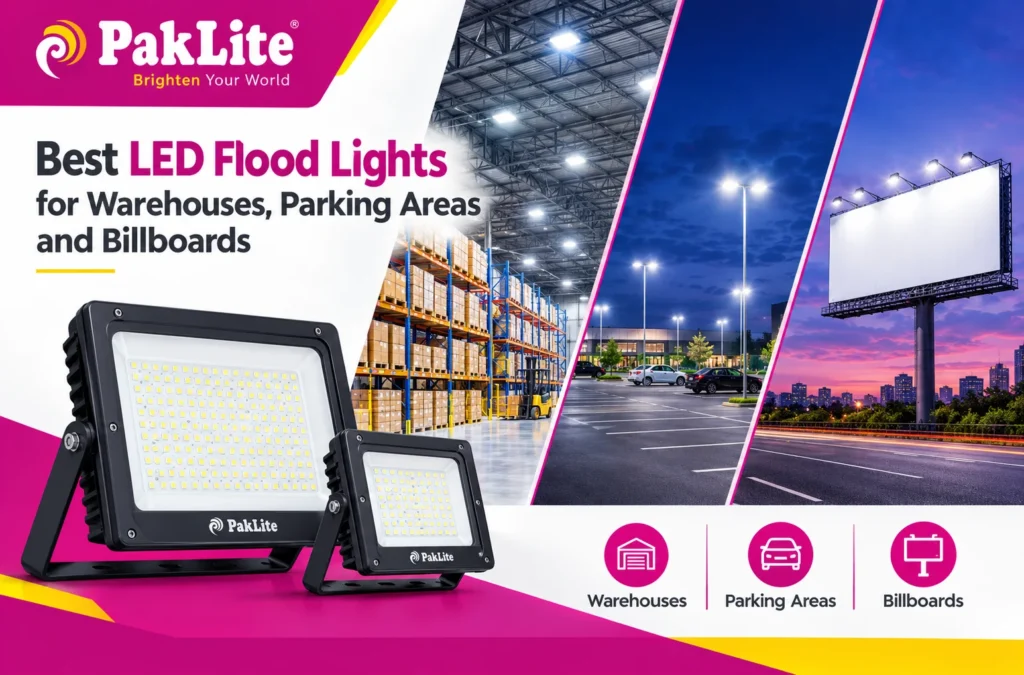
Best LED Flood Lights for Warehouses, Parking Areas and Billboards
A dark warehouse at night is not safe. Workers cannot see forklifts moving. Thieves find it easy to get in. A dark parking area feels unsafe too, so visitors stay away. A billboard with weak light wastes the whole ad, because no one can read it after sunset.
LED flood lights fix all three problems. But one light does not work everywhere. A light made for a warehouse is not always right for a billboard. A light made for a parking lot is not always right for a big factory yard. The right flood light depends on where you plan to install it and how much area you need to cover. Factors such as brightness, beam angle, IP rating, colour temperature, and mounting height can all affect lighting performance.
You can also browse our full range of
Paklite LED flood lights to find options for different outdoor and industrial lighting needs.
What Is an LED Flood Light?
An LED flood light is a high-output fixture built to spread bright, even light across a wide area rather than focus it on a single point. Unlike a spotlight, which throws a narrow beam under 45 degrees for accent or long-distance lighting, a flood light distributes light through a beam angle that typically ranges from 45 to 150 degrees. This wide spread is exactly what makes flood lights the standard choice for warehouses, parking lots, stadiums, building exteriors and billboards.
The difference between the two fixture types comes down to purpose. A spotlight highlights a flag, a sign or a specific architectural feature from a distance. A flood light illuminates an entire yard, a full parking lane or a complete billboard face without leaving dark patches. Choosing the wrong type for the job either wastes light and energy or leaves half the area in shadow.
| Feature |
Flood Light |
Spotlight |
| Beam angle |
45° to 150° |
Below 45° |
| Coverage |
Wide area |
One small point |
| Best for |
Warehouses, parking lots, billboards, yards |
Signs, flags, building fronts |
| Risk if wrong choice |
Wastes light and power |
Leaves dark spots |
Why Each Place Needs a Different Light
Good lighting is important in every space, but the right light depends on how the area is used. Warehouses, parking lots and billboards each need lighting that suits their purpose and covers the right area.
- Warehouses need bright lighting for loading areas, storage spaces, and outdoor yards. They need strong, tough lights that handle dust and knocks. Check Paklite’s industrial lighting range for this kind of job.
- Parking areas need even light with no glare, so drivers and walkers can see clearly. The light should turn on and off on its own at night. See Paklite’s parking lot lighting range for options built for this.
- Billboards need light that covers the whole sign evenly, with no dark corners. The wrong light makes the ad look patchy and hard to read.
Picking the right light for the best outdoor lighting does not always come from the highest wattage. So, choosing a light that fits the space and its purpose is the key to getting the right results from the start.
8 Simple Checks Before You Buy
Before buying an LED flood light, check a few important features to make sure it suits your space and lighting needs.
1. Watts Do Not Equal Brightness
Watts show how much power a light uses. They do not show how bright it is. Brightness is measured in lumens. Two 100W lights from two different brands can give very different amounts of light.
Lumens = Watts × Lumens per Watt
A good 100W light gives about 13,000 lumens. A cheap 100W light may give only 8,000 lumens for the same power. Always ask for the lumen number, not just the watt number.
2. Check Lumens per Watt
This number tells you how much light you get for each watt of power. Normal LED flood lights give 80 to 100 lumens per watt. Better ones give 130 lumens per watt or more. A higher number means a lower electricity bill for the same brightness.
3. Check the Beam Angle
The beam angle decides how far the light spreads.
- Narrow beams (30° to 60°) throw light far. Good for tall poles.
- Medium beams (60° to 90°) balance spread and strength. Good for most warehouses and parking lots.
- Wide beams (120° or a flat shape like 150°×80°) spread light evenly across a flat surface. Good for billboards.
A round beam on a billboard wastes light above and below the sign. A flat, direction beam sends light straight onto the sign instead.
4. Check the IP Rating
The IP rating tells you how well a light is sealed against dust and water.
- IP65 blocks dust and light water spray. Good for normal outdoor use.
- IP66 blocks dust and strong water jets. Good for heavy rain, dust and washdown areas.
- IP67 also survives short periods under water. Good for ground-level lights.
For a country like Pakistan, with dust, heat and monsoon rain, IP66 is a safer choice than IP65 for most outdoor sites.
5. Check the Light Colour (CCT)
CCT tells you if the light looks warm (yellow) or cool (white/blue). It is measured in Kelvin (K).
- 3000K is warm white. Good for homes and gardens.
- 4000K is neutral white. Good for general commercial use.
- 5000K to 6500K is cool white or daylight. Good for parking lots, billboards and security areas.
6. Check the CRI
CRI tells you how true colours look under the light. It is a number from 0 to 100. For a warehouse, 70 or higher is fine. For a billboard, where brand colours matter, look for 80 or higher. A low CRI can make a bright red logo look dull or brown.
7. Check the Driver and Surge Protection
The driver is the small part inside the light that controls the power. A good driver keeps the light stable and stops flicker. Pakistan’s power supply can have voltage spikes, so a light with strong surge protection will last much longer.
8. Check the Body, Lifespan and Warranty
Look for a metal body, usually die-cast aluminium, and a tough glass cover, not plastic. This helps the light survive heat, rain and knocks. A good LED flood light lasts 30,000 to 50,000 hours, and some premium models last even longer. Always check the warranty before you buy.
Best LED Flood Lights for Warehouses
Warehouses run lights for many hours, often all night. Loading docks, storage yards and building walls all need strong, steady light.
For a warehouse, look for:
- 100W to 300W for most yards and walls. Go for 400W or more for very large areas or tall poles.
- IP66 rating to handle dust and rain.
- A strong body that can take knocks near forklifts and machines.
- A medium to wide beam (60° to 120°) for even coverage.
- A motion sensor if you want the light to dim when no one is around, and turn bright again when someone arrives.
Switching from old metal halide lights to LED can cut a warehouse’s lighting bill by 60 to 75 percent. Paklite’s
LED Energy Flood Light and the higher-output
LED Xera Flood Light are both built for this kind of heavy daily use.
Best LED Flood Lights for Parking Areas
Parking lot lighting has two jobs. It must keep people safe, and it must keep the electricity bill low. A dark parking lot feels unsafe and puts visitors off.
For a parking area, look for:
- 50W to 200W per pole, depending on pole height and spacing.
- A wide, even beam (90° to 120°) so there are no dark gaps between poles.
- Anti-glare design, so drivers are not blinded by the light.
- Dusk-to-dawn control, so lights turn on and off automatically.
- A CCT of 5000K to 6500K, which helps security cameras see more clearly.
A smart layout with the right beam angle needs fewer poles than simply adding more lights. Paklite’s
parking lot lighting solutions page has options sized for small lots and large plazas alike.
Best LED Flood Lights for Billboards
Billboard lighting has one job: make the ad easy to read at night. If the light is wrong, the ad looks patchy, or money is wasted lighting up the sky instead of the sign.
For billboards, look for:
- A flat, direction beam (often 60°×120° or 90°×130°) that sends light straight onto the sign, not in a round cone.
- A CCT of 4000K to 6500K for a clean, bright look.
- A CRI of 80 or higher so logo colours stay true.
- IP65 as a minimum, or IP66 near the coast or in heavy rain areas.
- A light that keeps most of its brightness over time, instead of fading and looking dull after a few years.
To work out how many lumens a billboard needs, use this simple formula:
Total Lumens = Billboard Area (m²) × Target Lux
For example, a billboard 10 metres wide and 3 metres high covers 30 square metres. At a target of 500 lux, you need 30 × 500, which is 15,000 lumens. This can come from two 100W lights at around 130 lumens per watt, placed to spread light evenly across the sign.
Paklite’s
LED Power Flood Light and
LED Energy Flood Light both come with adjustable brackets, which make it easy to angle the beam correctly onto a billboard face.
Wattage and Lumen Guide
Always check the actual lumen output given by the manufacturer, as it can vary between brands. Use this table as a basic guide when choosing wattage and lumens.
| Wattage |
Approx. Lumens |
Best For |
| 30W – 50W |
3,900 – 6,500 |
Entrances, small signs, driveways |
| 100W |
10,000 – 13,000 |
Billboards, small parking areas, building walls |
| 150W |
16,000 – 19,500 |
Medium parking lots, warehouse walls |
| 200W |
22,000 – 26,000 |
Large parking lots, loading docks |
| 300W |
33,000 – 39,000 |
Warehouse yards, large billboards |
| 400W and up |
45,000+ |
Container yards, stadiums, tall poles |
LED vs Old-Style Lights (HID/Halogen)
| Point |
LED Flood Lights |
HID / Halogen |
| Power use |
60% to 75% lower for the same brightness |
High, most power turns into heat |
| Lifespan |
30,000 to 100,000 hours |
6,000 to 15,000 hours |
| Startup |
Full bright light at once |
Takes time to warm up |
| Brightness over time |
Stays steady for most of its life |
Fades as it gets older |
| Upkeep cost |
Low, rarely needs changing |
High, needs regular changing |
| Safety |
No mercury inside |
Contains harmful materials |
Why Choose Paklite LED Flood Lights
Pakistan’s weather is tough on outdoor lights. There is strong heat, dust storms, monsoon rain and voltage ups and downs on the power grid. A light made only for mild weather often fails early here. Paklite has made lighting in Pakistan since 1986 and builds its outdoor lights for these exact conditions.
The
Paklite flood light range includes these features:
- IP66-rated body that handles dust, rain and washdown.
- Die-cast aluminium body with tempered glass, for strength and heat control.
- A choice of light colour, 3000K, 4000K or 6500K, so one model suits many uses.
- A light, easy-to-mount design, about 30 percent lighter than older flood lights, with an adjustable bracket for wall or ground use.
Power options range from 50W in the
LED Energy Flood Light up to higher outputs in the
LED Xera Flood Light and
LED Power Flood Light, so there is a size for a small shop front and a size for a large parking plaza.
Paklite lights already work in hospitals, universities and factories across Pakistan. Factory warranty and support come with every light, and you can
find your nearest Paklite dealer here or contact our team directly for help choosing the right model.
Frequently Asked Questions
What wattage do I need for my warehouse?
It depends on the size of your yard and how high your poles are. As a simple rule, 100W to 300W covers most warehouse walls and yards. Very large areas or tall poles may need 400W or more.
What IP rating is best for Pakistan?
IP65 is the lowest level for outdoor use, but IP66 is a better fit for most of Pakistan. It handles dust, heat and monsoon rain much better than IP65.
How many lumens does a parking lot need?
Most parking lots need 5 to 20 lux, depending on how busy or secure the area is. Multiply the lot size in square metres by the target lux to get the total lumens you need. Then divide by the lumen output of one light to see how many lights you need.
Can I use the same light for a warehouse and a billboard?
You can, but it will not work as well. A warehouse needs a wide, round beam for general coverage. A billboard needs a flat, direction beam so the light lands evenly on the sign. Using the wrong type leaves dark corners on a billboard.
How long do LED flood lights last?
A good LED flood light lasts 30,000 to 100,000 hours. At around 10 to 12 hours of use a night, this can mean 7 to more than 20 years of use before you need to replace it.
Are LED lights more expensive than old-style lights?
The starting price is usually higher. But LED lights use 60 to 75 percent less power and last much longer. Over time, this makes LED the cheaper choice once you count the savings on electricity and repairs.