
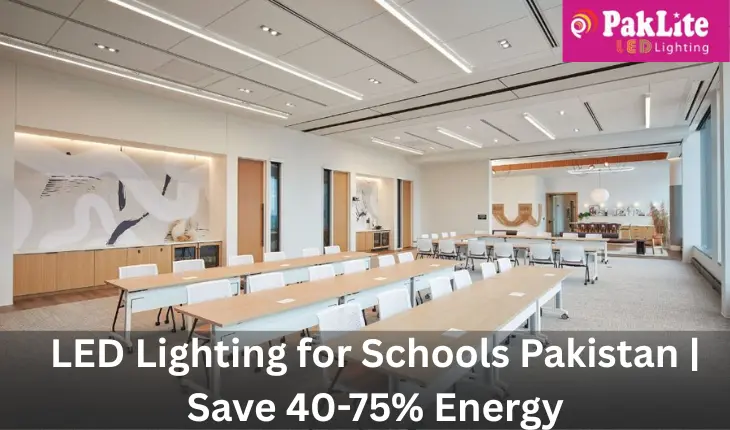
Pakistan’s educational institutions face a critical challenge: balancing quality learning environments with soaring electricity costs. With power tariffs climbing and load shedding affecting daily operations, schools and universities across Pakistan are seeking sustainable solutions. LED lighting technology has emerged as a game-changing investment that addresses both financial and educational priorities.
Recent pilot projects in Pakistan demonstrate remarkable results. Quaid-i-Azam University’s Central Library achieved 36.5 MWh annual energy savings after LED retrofitting, equivalent to PKR 730,320 in cost savings. Similarly, the National Energy Efficiency and Conservation Authority (NEECA) building reduced consumption by 12.4 MWh annually, with a payback period of just 10 months.
This comprehensive guide explores how Pakistani educational institutions can implement strategic LED lighting designs to reduce energy consumption by 40-75%, improve student performance, and create sustainable learning environments.
Understanding the Energy Crisis in Pakistani Educational Institutions
Current Lighting Challenges
Most Pakistani schools and universities still operate with outdated fluorescent tubes and incandescent bulbs installed decades ago. These traditional systems consume excessive electricity while delivering poor-quality illumination that affects student concentration and eye health.
Key Statistics:
- Traditional lighting accounts for 25-35% of total electricity consumption in educational buildings
- Fluorescent tubes waste 60-70% of energy as heat
- Average replacement frequency: every 8,000-10,000 hours
- Pakistan’s educational sector could save 12 TWh annually through LED adoption
Financial Impact
With commercial electricity tariffs ranging from PKR 18-25 per unit, inefficient lighting significantly strains institutional budgets. A typical 50,000 square foot school building spends PKR 400,000-600,000 annually on lighting alone.
Why LED Lighting is Essential for Pakistani Schools
1. Dramatic Energy Reduction
LED technology uses 40-80% less electricity compared to traditional lighting:
Comparison Table:
- 36W Fluorescent Tube: 36W consumption → Replace with 18W LED = 50% savings
- 60W Incandescent Bulb: 60W consumption → Replace with 9W LED = 85% savings
- 150W Metal Halide (Gym): 150W consumption → Replace with 60W LED = 60% savings
2. Extended Lifespan
LED fixtures last 50,000-100,000 hours compared to:
- Fluorescent tubes: 10,000-15,000 hours
- Incandescent bulbs: 1,000-2,000 hours
- CFL bulbs: 8,000-10,000 hours
This longevity translates to reduced maintenance costs and fewer classroom disruptions for bulb replacements.
3. Improved Learning Outcomes
Research demonstrates that proper LED lighting enhances:
- Student Concentration: Cool white LEDs (4000-5000K) increase alertness during morning classes
- Reading Comprehension: High CRI (>80) LEDs improve text clarity
- Reduced Eye Strain: Flicker-free operation prevents headaches and fatigue
- Mood Enhancement: Tunable white systems support circadian rhythms
4. Weather Resistance for Pakistan’s Climate
Quality LED fixtures withstand Pakistan’s extreme conditions:
- Summer temperatures exceeding 45°C
- Heavy monsoon rains
- Dust storms and high humidity
- Voltage fluctuations (common in Pakistan’s grid)
Comprehensive LED Lighting Design Strategy
Step 1: Conduct a Lighting Audit
Before implementing changes, assess your current infrastructure:
Audit Checklist:
- Document all existing fixtures, wattages, and quantities
- Measure current illumination levels (in lux or foot-candles)
- Calculate monthly/annual electricity consumption for lighting
- Identify problematic areas (dark corridors, over-lit spaces)
- Note fixture mounting heights and ceiling types
Professional Tip: Many LED suppliers in Pakistan, including PakLite, offer free lighting audits to educational institutions.
Step 2: Design Room-by-Room Solutions
Different educational spaces require specific lighting approaches:
Classrooms (Primary Focus Area)
- Recommended Illumination: 300-500 lux (30-50 foot-candles)
- Best Fixtures: LED panel lights (600x600mm or 600x1200mm)
- Color Temperature: 4000K (neutral white) for optimal concentration
- Controls: Daylight sensors to adjust brightness based on natural light
Libraries and Reading Rooms
- Recommended Illumination: 500-750 lux
- Best Fixtures: LED panel lights with high CRI (>90)
- Color Temperature: 4000-4500K
- Features: Individual task lighting at reading desks
Corridors and Stairways
- Recommended Illumination: 100-200 lux
- Best Fixtures: LED batten lights or linear strips
- Controls: Motion sensors to prevent energy waste
- Safety: Emergency lighting backup systems
Gymnasiums and Assembly Halls
- Recommended Illumination: 300-500 lux
- Best Fixtures: LED high bay lights (UFO design)
- Features: Dimmable controls for different activities
- Durability: Impact-resistant housing (IP65 rated)
Outdoor Areas (Playgrounds, Parking)
- Recommended Illumination: 50-150 lux
- Best Fixtures: LED flood lights and street lights
- Features: Photocells for automatic dusk-to-dawn operation
- Security: Motion-activated lighting in low-traffic areas
Administrative Offices
- Recommended Illumination: 400-500 lux
- Best Fixtures: LED panel lights or troffers
- Color Temperature: 4000-4500K
- Ergonomics: Adjustable desk lamps for computer work
Step 3: Calculate Return on Investment
Sample Calculation for a Mid-Size School (40,000 sq ft):
Current System:
- 200 fluorescent fixtures (4x36W tubes each) = 28,800W
- 100 incandescent bulbs (60W each) = 6,000W
- Total: 34,800W running 10 hours/day, 250 days/year
Annual Consumption: 87,000 kWh Annual Cost (@ PKR 20/unit): PKR 1,740,000
LED Upgrade:
- 200 LED panels (40W each) = 8,000W
- 100 LED bulbs (9W each) = 900W
- Total: 8,900W
Annual Consumption: 22,250 kWh Annual Cost: PKR 445,000 Annual Savings: PKR 1,295,000 (74% reduction)
Investment:
- LED fixtures and installation: PKR 1,800,000-2,500,000
- Payback Period: 1.5-2 years
- 20-Year Savings: PKR 25,900,000
Step 4: Implement Smart Lighting Controls
Maximize savings through automation:
Control Systems:
- Occupancy Sensors: Auto-shutoff in unoccupied classrooms (saves 20-30%)
- Daylight Harvesting: Dims LEDs when natural light is sufficient (saves 15-25%)
- Time Scheduling: Automatic on/off based on school timings
- Centralized Management: Monitor and control entire campus from one dashboard
Pakistan-Specific Consideration: Choose systems compatible with voltage fluctuations (170V-270V range).
Implementation Roadmap for Pakistani Institutions
Phase 1: Priority Areas (Months 1-3)
Start with high-impact, high-visibility spaces:
- Main classrooms and lecture halls
- Computer labs (where quality lighting is critical)
- Administrative offices
- Main entrance and reception
Phase 2: Common Areas (Months 4-6)
Expand to:
- Corridors and stairways
- Washrooms and changing rooms
- Libraries and study halls
- Staff rooms
Phase 3: Specialized Spaces (Months 7-9)
Complete with:
- Gymnasiums and sports facilities
- Science laboratories
- Auditoriums and assembly halls
- Outdoor lighting
Phase 4: Optimization (Months 10-12)
Fine-tune the system:
- Install advanced controls
- Adjust lighting levels based on user feedback
- Monitor energy savings
- Train maintenance staff
Selecting the Right LED Products for Pakistan
Quality Indicators
Look for these certifications and specifications:
Essential Certifications:
- PSQCA (Pakistan Standards & Quality Control Authority) certified
- ISO 9001 quality management
- EN 12464-1 compliance (European lighting standard)
- IP65 rating for outdoor fixtures (dust and water resistant)
Technical Specifications:
- Lumens per Watt: >100 lm/W (high efficiency)
- Color Rendering Index (CRI): >80 (>90 for detailed work)
- Power Factor: >0.9 (reduces electricity waste)
- Operating Temperature: -10°C to 50°C (Pakistan climate suitable)
- Voltage Range: 85V-285V (handles fluctuations)
Pakistan-Made vs. Imported
Advantages of Pakistan-Made LEDs (e.g., PakLite):
- Designed for local climate and voltage conditions
- Easier warranty claims and technical support
- Faster replacement part availability
- Support local manufacturing sector
- Often 20-30% more cost-effective
When to Consider Imports:
- Specialized applications (theatrical lighting, precision labs)
- Advanced control systems not available locally
- Grant-funded projects with specific brand requirements
Funding and Financial Assistance
Available Programs in Pakistan
- State Bank of Pakistan Green Refinance Scheme
- Low-interest loans for energy efficiency projects
- Up to 10-year repayment period
- Contact: SBP Green Banking Department
- Provincial Energy Efficiency Initiatives
- Punjab Energy Efficiency and Conservation Agency (PEECA)
- Sindh Energy Department grants
- KP and Balochistan renewable energy programs
- International Development Funds
- USAID education sector support
- World Bank educational infrastructure grants
- Asian Development Bank sustainability programs
- Tax Benefits
- Accelerated depreciation on energy-efficient equipment
- Sales tax exemptions (verify current regulations)
Leasing and ESCO Models
Energy Service Company (ESCO) Option:
- Zero upfront investment
- ESCO installs and maintains LED systems
- Institution pays from energy savings
- Ownership transfers after contract period (typically 5-7 years)
Maintenance and Long-Term Management
Preventive Maintenance Schedule
Monthly:
- Visual inspection for flickering or dimming
- Clean fixture lenses (dust accumulation reduces output)
- Test emergency lighting systems
Quarterly:
- Deep clean outdoor fixtures
- Check all control sensors and timers
- Verify mounting security
Annually:
- Professional electrical inspection
- Comprehensive performance audit
- Update control system programming
Training Staff
Develop in-house expertise:
- Train electricians on LED installation and troubleshooting
- Educate facility managers on control system operation
- Create documentation library (wiring diagrams, product manuals)
- Establish vendor relationships for technical support
Case Studies: Pakistani Institutions Leading the Way
Quaid-i-Azam University, Islamabad
Project Scope: Central Library LED retrofit Investment: PKR 424,360 Results:
- 36.5 MWh annual energy savings
- PKR 730,320 annual cost reduction
- 23 tons CO₂ emissions reduced
- Improved student satisfaction scores
NEECA Building, Islamabad
Project Scope: Complete LED conversion Investment: PKR 214,260 Results:
- 12.4 MWh annual energy savings
- PKR 248,780 annual cost reduction
- 10-month payback period
- 7.9 tons CO₂ reduction
Riphah International University
Project Scope: Campus-wide LED implementation (PakLite products) Benefits:
- 60% reduction in lighting energy consumption
- Enhanced classroom learning environment
- Reduced maintenance burden
- Improved campus aesthetics
Common Mistakes to Avoid
1. Choosing Based on Price Alone
Issue: Low-quality LEDs fail quickly, negating savings Solution: Evaluate total cost of ownership (TCO) over 10+ years
2. Incorrect Light Levels
Issue: Over-lighting wastes energy; under-lighting affects learning Solution: Follow IES (Illuminating Engineering Society) guidelines
3. Ignoring Color Temperature
Issue: Wrong temperature affects mood and productivity Solution: Match temperature to activity (cool for focus, warm for relaxation)
4. Poor Quality Control
Issue: Inconsistent fixtures create uneven lighting Solution: Purchase from reputable manufacturers with batch consistency
5. Inadequate Planning
Issue: Piecemeal upgrades create inefficiencies Solution: Develop comprehensive campus-wide strategy
Environmental and Social Impact
Carbon Footprint Reduction
By switching to LEDs, a typical 50,000 sq ft educational institution in Pakistan can:
- Reduce CO₂ emissions by 40-50 tons annually
- Equivalent to planting 1,000+ trees
- Support Pakistan’s climate change commitments
Student Well-Being Benefits
Proper LED lighting contributes to:
- Reduced absenteeism (fewer headaches and eye strain)
- Improved test scores (better concentration)
- Enhanced mood and school satisfaction
- Better sleep patterns (circadian rhythm support)
Community Leadership
Educational institutions that embrace LED technology:
- Demonstrate environmental stewardship
- Educate students about sustainability
- Inspire community adoption
- Position themselves as forward-thinking organizations
Future Trends in Educational Lighting
1. Human-Centric Lighting (HCL)
Dynamic systems that adjust color temperature throughout the day to support circadian rhythms and optimize alertness.
2. Li-Fi Technology
LED fixtures that transmit data through light waves, creating wireless communication networks for smart classrooms.
3. Solar-Integrated Systems
Hybrid solutions combining rooftop solar panels with LED lighting for complete energy independence.
4. AI-Powered Optimization
Machine learning algorithms that analyze usage patterns and automatically optimize lighting schedules and intensities.
Frequently Asked Questions
Q1: What is the typical payback period for LED lighting in Pakistani schools?
Most educational institutions achieve full payback within 1.5-3 years, depending on current electricity costs and usage patterns. With rising tariffs, payback periods are becoming shorter.
Q2: How do I handle the initial investment cost?
Consider phased implementation starting with high-impact areas, explore ESCO financing options, apply for government energy efficiency grants, or investigate low-interest green loans from State Bank of Pakistan.
Q3: Will LED lights work during voltage fluctuations common in Pakistan?
Quality LED fixtures designed for Pakistan (like those from PakLite) include built-in drivers that handle voltage ranges from 85V-285V, making them ideal for unstable grid conditions.
Conclusion
LED lighting represents one of the most impactful investments Pakistani educational institutions can make. Beyond the 40-75% energy savings and reduced operational costs, modern LED systems create healthier learning environments that directly benefit student performance and well-being.
As demonstrated by successful implementations at Quaid-i-Azam University, Riphah International, and NEECA facilities, the transition to LED lighting delivers measurable financial returns while supporting Pakistan’s sustainability goals.
For schools and universities ready to make this transformation, the roadmap is clear: conduct a thorough audit, design a comprehensive solution tailored to your specific needs, select quality fixtures from reputable manufacturers, and implement in strategic phases.
The future of educational lighting in Pakistan is bright—powered by energy-efficient, sustainable LED technology.
Ready to transform your educational institution with LED lighting?
Contact PakLite’s project lighting division for a complimentary lighting audit and customized proposal. With Pakistan-made quality, factory warranties, and nationwide support, we illuminate the path to energy savings and enhanced learning environments.